This sample report uses fictional information to demonstrate the format. It is not a real client record, a testimonial or advice for your own care.
Start with the question behind the testing
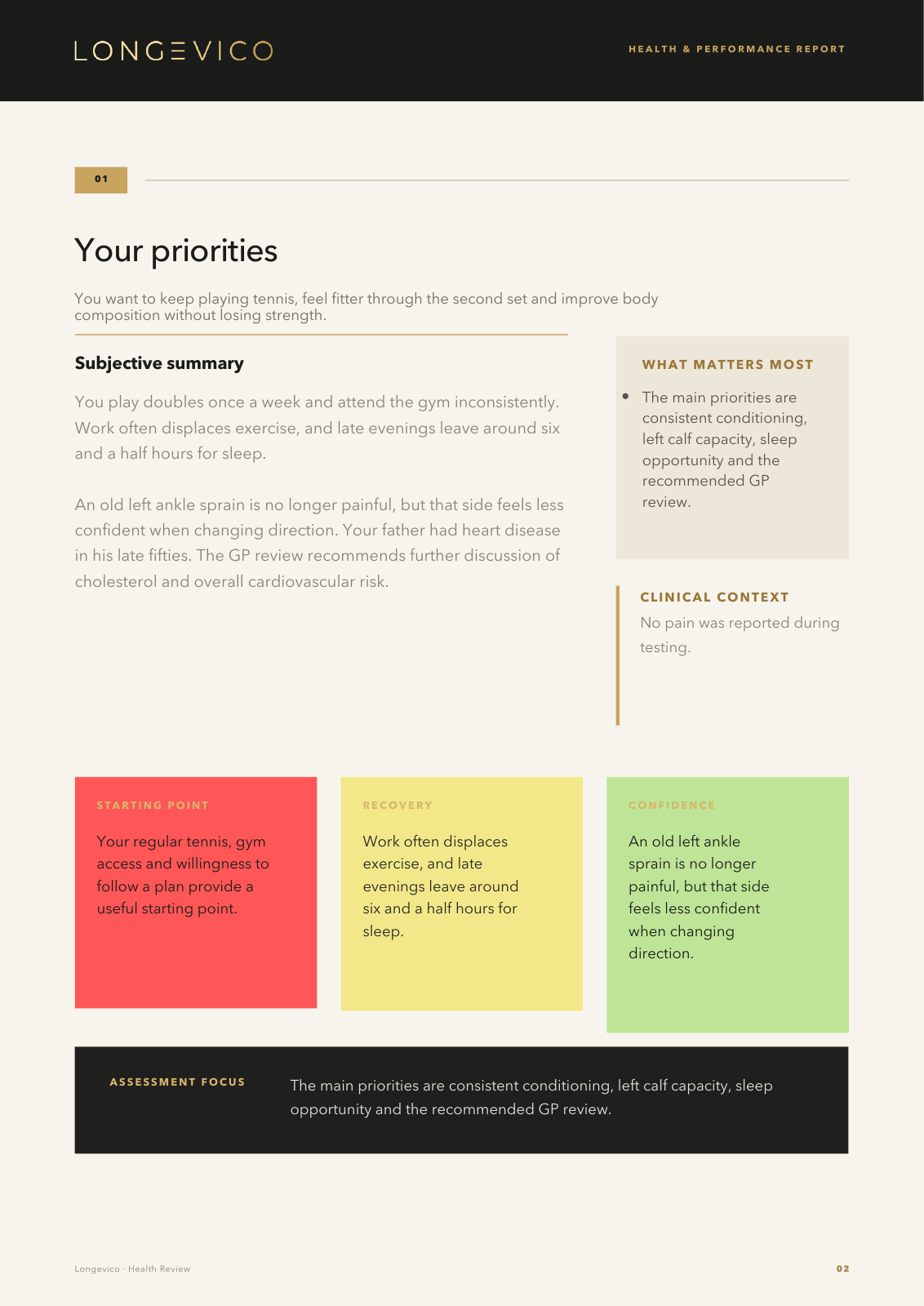
The person in this report is a man aged 52 who wants to keep playing tennis and feel fitter through the second set. His gym routine is inconsistent, work limits his available time and an old ankle injury affects his confidence when changing direction.
He also wants to improve body composition without losing strength. His family history and cholesterol results require discussion with his GP.
Those details create several different questions. What physical capacity should his training address? What can fit into his week? Which findings need medical input? A single fitness score cannot answer all of them.
A result should lead to a decision, not just a label
Scroll to see all columns.
| Finding in the report | How it contributes to the plan |
|---|---|
| Calf raises: 18 on the left and 23 on the right. | Left calf endurance becomes one training priority, considered alongside ankle movement and confidence on court. |
| Directly measured cycle VO₂ peak: 30.5 mL·kg⁻¹·min⁻¹. | Establishes an aerobic baseline. It is not assigned an unsupported age percentile or treated as the sole explanation for fading during tennis. |
| Body fat: 27.5%; lean tissue: 61.2 kg. | Provides body composition context. Strength and function remain separate outcomes to review. |
| Lipid results and family history. | Medical review stays with the GP. Relevant medical advice informs the exercise component. |
For the calf raise comparison, the report calculates asymmetry as the higher result minus the lower result, divided by the higher result, multiplied by 100. That gives 21.7%.
The percentage describes the comparison. It is not a prediction that this person will sustain an injury or a universal threshold that must be reached before playing tennis. The next decision still needs symptoms, confidence, movement and the demands of the activity.
Notice what the report does not claim
The whole body scan in this example provides body composition information. Diagnostic hip and spine bone density was not assessed. The report says so rather than inventing a T score or treating another measurement as a substitute.
The blood results are not classified against made up laboratory intervals. Medical targets need the actual reporting context and the GP’s assessment.
The aerobic result is a baseline, not a forecast of the person’s lifespan. These distinctions matter because missing information should remain visible rather than become a confident sounding conclusion.
Read the actual report
Open the Canva report to follow the six sections: overview, priorities, physical capacity, aerobic capacity and body composition, blood results, and the plan.
As you read, look for the link between the person’s original goals, the findings selected for attention and the measures proposed for review. The report is intended to be used in that sequence, not simply scanned for the highest or lowest number.
A plan also needs a way to check progress
This example sets out strength and conditioning priorities, recovery considerations and GP follow-up. It proposes an initial review after four weeks and reassessment of selected physical measures at 12 weeks.
The useful review questions are practical: Was the routine completed? How did it fit around tennis? What happened to confidence and exercise tolerance? Which measures would help decide the next adjustment?
Those intervals belong to this example. They are not a promise that every person will need the same program or schedule. An exercise plan needs to respond to what is happening, including information from the treating team.
Which service includes this kind of report?
The integrated Health & Performance Report belongs to the Longevico Health Review. It brings the selected information together with priorities and a plan to begin.
A focused Clinical Exercise Assessment is a different service with its own written summary. You do not need to purchase the Health Review simply because you have one question about exercise or an existing test result.
Related reading
Evidence and further reading
- Ardern CL, et al. 2016 Consensus statement on return to sport from the First World Congress in Sports Physical Therapy, Bern. British Journal of Sports Medicine. 2016;50(14):853–864. doi:10.1136/bjsports-2016-096278. Read source
- Smith MD, et al. Return to sport decisions after an acute lateral ankle sprain injury: introducing the PAASS framework, an international multidisciplinary consensus. British Journal of Sports Medicine. 2021;55(22):1270–1276. doi:10.1136/bjsports-2021-104087. Read source
- International Society for Clinical Densitometry. Official Adult Positions. 2023. Bone density interpretation, follow-up measurement, precision and body composition. Read source
- Nana A, Slater GJ, Stewart AD, Burke LM. Methodology Review: Using Dual-Energy X-Ray Absorptiometry (DXA) for the Assessment of Body Composition in Athletes and Active People. International Journal of Sport Nutrition and Exercise Metabolism. 2015;25(2):198–215. doi:10.1123/ijsnem.2013-0228. Read source
- Lang JJ, et al. Cardiorespiratory fitness is a strong and consistent predictor of morbidity and mortality among adults: an overview of meta-analyses representing over 20.9 million observations from 199 unique cohort studies. British Journal of Sports Medicine. 2024;58(10):556–566. doi:10.1136/bjsports-2023-107849. Read source