
Describe when the ankle or calf starts to feel different
A calf that fades on longer hills and an ankle that feels less steady on uneven ground give us different questions to explore. Tell us which terrain, distance or pace brings on the change.
Single leg calf raise
We may observe how high you lift the heel, how many controlled raises you can repeat and how height or control changes as you tire. We use a consistent position, pace and amount of support to compare sides or check again later.
Watch how the heel lifts and lowers on one leg. A clinician can record how the height and control hold up over a set.
Ankle dorsiflexion strength
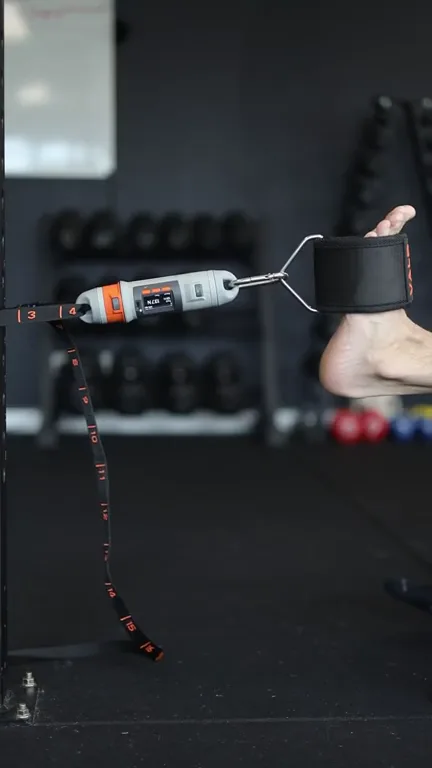
Dorsiflexion means lifting the front of your foot towards your shin. The strap resists the effort so the DynaMo can measure force. If we also want to know how far the ankle moves, we can use a separate range of movement test.
You lift the front of your foot towards your shin against the strap. This checks the strength of that effort.
Ankle strength inwards and outwards
Inversion turns the sole inwards. Eversion turns it outwards. These tests let us measure the two efforts separately. How that information guides exercise depends on what you notice during running and how you manage other movement tasks.
You try to turn the sole inwards against the strap. The device measures force in that direction.
You try to turn the sole outwards against the strap. The device measures force in that direction.